
A contractor in northern Ghana sent me a video last month. His 5-inch hammer was making a sound I know too well — a flat, lazy thud instead of the sharp crack you want. The pressure gauge on the compressor read a healthy 10 bar. At the hammer, it was closer to 7.
He had bought the machine on CFM alone. Nobody had asked him what pressure the hammer needed at the bottom of a 90 m hole.
That is the single most expensive mistake in this part of the business. A compressor that is technically “big enough” can still be the wrong compressor, because air is not a fixed quantity. It is a volume that shrinks as pressure rises and as the air gets thinner with altitude and heat.
This guide is about choosing the machine itself — type, rating, mounting and the field conditions that quietly steal your air. If you want the arithmetic for sizing air to a specific hammer, that lives in our DTH hammer air requirements guide. Here we deal with the purchase decision.
What the Compressor Is Actually Driving
People talk about “the compressor for the rig” as if a rig consumes air. It does not. The rig consumes diesel or hydraulic power. The air goes to one of three places:
- A DTH hammer, where air is the piston’s power source and also the only thing clearing cuttings from the hole.
- An air-leg rock drill, where air drives the piston and pressurises the leg that feeds the drill.
- Cleaning and blow-down, where air clears the collar, dries the hole and blows out the lines.
Only the first two matter for sizing, and they behave differently. A hammer wants high pressure and a steady volume. An air leg wants moderate pressure and can tolerate a smaller machine, but it punishes an undersized one with slow drilling and burned steel. If you run both from one compressor — common on small water well crews — you size for the sum, not the larger of the two.
Screw vs Piston: The Choice That Decides Everything Else
Almost every portable compressor sold into drilling today is a rotary screw. Piston machines still exist, mostly in workshops and small farms, and they turn up in drilling quotes because they are cheap.
Here is the honest comparison. I have sold both, and I have watched customers regret both directions.
| Factor | Rotary screw | Reciprocating piston |
|---|---|---|
| Duty cycle | Continuous — built to run all shift | Intermittent — typically 50–70% duty |
| Pressure stability | Steady, small ripple | Pulsing delivery, noticeable at the hammer |
| Efficiency at 10–12 bar | Good across the range | Falls away quickly above 7–8 bar |
| Weight and footprint | Compact for the air delivered | Heavy per CFM, large receiver needed |
| Service cost | Higher parts cost, longer intervals | Cheaper parts, more frequent attention |
| Noise | Canopied units are tolerable | Loud, hammering exhaust note |
| Best use | DTH, production air-leg work, 8-hour shifts | Short jobs, backup, workshop air |
My rule is blunt: if the drill runs more than four hours a day, buy screw. A piston machine rated at the same CFM will deliver less air at pressure, will heat the air more, and will be the reason your hammer sounds tired by mid-afternoon. The money you save at purchase comes back as downtime.
The one case for piston
Short, intermittent work with modest pressure. A two-man crew drilling 20 m of 76 mm hole a week, or a service truck that needs air for blow-down and a jackhammer. In that setting a piston machine is genuinely cheaper to own. It is not a drilling compressor, and it should not be sold as one.
Reading the Spec Sheet Without Getting Fooled
Three numbers on a compressor plate decide whether it will run your hammer. Two of them are routinely misread.
FAD, not displacement
Free air delivery (FAD) is the volume of air the machine actually delivers, measured at intake conditions. Displacement is the swept volume of the compressor element. Displacement is always larger — sometimes by 20–30%. Chinese catalogue pages often quote one and label it the other, sometimes by accident, sometimes not.
Ask for FAD in m³/min or CFM, and ask at what pressure. A machine rated “6 m³/min” that only makes that figure at 7 bar is a different machine from one that holds 6 m³/min at 10 bar.
Working pressure at the hammer, not at the gauge
Every metre of hose, every elbow, every quick coupler costs you pressure. On a typical 30 m run of 1-inch hose with a few fittings, expect to lose a few tenths of a bar before the air even reaches the head. Add depth, and the column of air in the drill pipe adds its own loss.
So when a hammer asks for 10 bar working pressure, a 10 bar compressor is marginal. You want headroom. This is why the same hammer that drills well at 30 m starts sulking at 90 m on the same machine.
| You read | It means | Rough conversion |
|---|---|---|
| 6 m³/min | Free air delivery | ≈ 212 CFM |
| 6.5 m³/min | Free air delivery | ≈ 230 CFM |
| 8.5 m³/min | Free air delivery | ≈ 300 CFM |
| 1.0 MPa | Working pressure | 10 bar ≈ 145 psi |
| 1.2 MPa | Working pressure | 12 bar ≈ 174 psi |
| 55–90 kW | Engine power | ≈ 74–121 hp |
Matching the Machine to the Method
The table below is the practical version we use in quotations. Treat the air figures as bands, not promises — hammer brands differ, and a worn hammer needs more air than a new one.
| Work | Typical air demand | Pressure | Our model |
|---|---|---|---|
| 1–2 air-leg drills (Hex 22) | 3–5.5 m³/min total | 6–7 bar | TDS-C600 (6 m³/min, 10 bar) |
| 3–4 inch DTH hammer, shallow holes | 5–7 m³/min | 10–12 bar | TDS-C600 or TDS-C650 |
| 4–5 inch hammer, 60–120 m | 7–9 m³/min | 10–12 bar | TDS-C650 (6.5) or TDS-C850 (8.5) |
| 5–6 inch hammer, deep or hard rock | 9–14 m³/min | 12–17 bar | TDS-C850 (8.5 m³/min, 12 bar); above that, a high-pressure unit |
| Air-leg crew plus occasional hammer | Sum of both, plus 20% | Highest of the two | Step up one size — usually C650 or C850 |
Notice the last row. Crews try to save money by buying one machine for everything, then discover that running a hammer and two legs together starves all three. If that is your pattern, size for the sum and accept the larger unit. The drilling rig range and drilling tools pages list what each rig is normally paired with.
Towable, Skid or Truck-Mounted
This is a logistics question dressed up as an engineering one. The compressor is usually the heaviest thing you move that does not drill.
- Towable — two wheels and a drawbar. Fastest to reposition on flat ground, worst on mud, sand and steep access. Fine for most water well work where you can get a pickup or Land Cruiser to the site.
- Skid-mounted — no wheels, lifted by crane or forklift, or dragged onto a flatbed. Better for quarry benches and sites where the machine stays put for weeks.
- Truck-mounted — permanently on a chassis with the rig. Least flexible, but you never forget the compressor and you never need a second vehicle.
Two details that catch people out. First, a towable unit’s tyres and bearings are not rated for highway speed over long distances; if the site is 400 km away, it travels on a truck, not behind it. Second, a canopied screw compressor pulls cooling air through louvres — park it with the fan side into the wind and give it space, or it will derate on a hot afternoon.
Diesel or Electric
Diesel is the default because most drilling happens where there is no grid. Electric makes sense in three situations: a quarry with reliable three-phase power, an indoor or urban site where exhaust is a problem, and a permanent yard where the compressor runs a fixed circuit.
Electric units are cheaper per hour and need less maintenance. But they need cable sized for starting current, a changeover arrangement you trust, and someone who will not unplug the compressor to run a welder. On a remote water well site, diesel wins on availability alone. We supply diesel as standard on the C600, C650 and C850; if you need an electric drive for a fixed installation, tell us at quotation stage rather than after delivery.
Heat, Altitude and Dust: The Silent Air Thieves
This is where the Ghana story comes from. A compressor is rated at standard intake conditions. Move it to 1,800 m in the Ethiopian highlands or 45 °C in the Sahel and the same machine delivers less air, at less pressure, on more fuel.
Two rules of thumb I give customers, both approximate:
- Altitude — roughly 3% loss of mass airflow per 300 m above about 1,000 m on a naturally aspirated engine. Turbocharged units lose less, but they still lose.
- Temperature — intake air at 45 °C is about 6–7% less dense than at 25 °C. Output falls roughly in proportion.
Put those together and a 6.5 m³/min machine can behave like a 5.6 m³/min machine on a hot highland site. That is the difference between a hammer that fires cleanly and one that thuds. If you drill in those conditions, buy one size up — it is cheaper than a second compressor flown in.
Dust is the other thief, and it is not about output. A clogged air filter element drops intake pressure, the engine compensates with fuel, and the element eventually fails and sends dirt into the compressor oil. In quarry and dry-season work, check the element weekly and the restriction indicator daily. This is the cheapest maintenance you will ever do.
Water in the Line: The Hammer Killer
Compressed air comes out hot and wet. Cool it and the water drops out — in the separator, in the hose, or in the hammer. The last one is the problem.
Water washes the oil film off the hammer’s piston and cylinder. Once that film is gone, you get metal on metal for a few hundred strokes, and the wear shows up weeks later as falling penetration and rising air consumption. I have seen a hammer destroyed in a fortnight by a separator that nobody drained.
The fix is unglamorous. Drain the separator and receiver at the end of every shift, not every week. Keep the aftercooler and radiator clean so the air actually cools before the separator. In humid coastal work, add a second trap near the rig. And follow the lubrication routine in our DTH hammer lubrication and break-in guide — oil and water together make an emulsion that lubricates nothing.
Service Intervals and Fuel Burn
Two costs people forget when comparing quotes.
Service. A screw compressor has three consumables that matter: the air filter, the oil filter and the oil/air separator. In clean conditions, filters at around 500 hours and separator at around 2,000 hours is a normal pattern; in quarry dust, halve the filter interval. The separator is the expensive one, and it is also the one that gets skipped — a blocked separator shows up as high oil carry-over and a hot machine, not as an obvious failure.
Fuel. A diesel compressor burns roughly 0.2–0.25 litres per kWh of shaft work. A 90 kW machine at 80% load is therefore in the 15–18 litres per hour range, and a 55 kW machine at the same load is around 9–11 litres per hour. On a 10-hour shift that difference is real money, which is why buying the smallest machine that genuinely does the job usually beats buying the biggest one you can afford.
The Three Models We Actually Ship
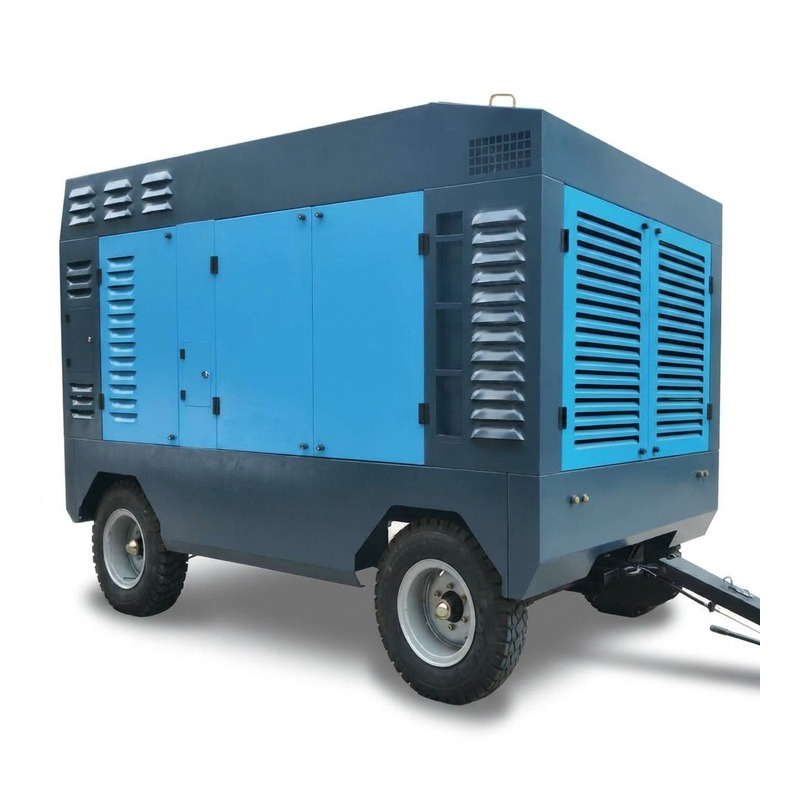
All three are diesel, air-cooled, canopied screw compressors. The differences are output, pressure and weight — and the weight matters more than people expect when the site is a muddy track.
| Model | Free air delivery | Working pressure | Engine | Weight | Best for |
|---|---|---|---|---|---|
| TDS-C600 | 6 m³/min (≈212 CFM) | 1.0 MPa / 10 bar | ≈55 kW diesel | ≈1,500 kg | Air-leg crews, 3–4 inch hammers, shallow water wells |
| TDS-C650 | 6.5 m³/min (≈230 CFM) | 1.0 MPa / 10 bar | ≈64 kW diesel | ≈1,650 kg | 4 inch hammers to 100 m, mixed air-leg and hammer work |
| TDS-C850 | 8.5 m³/min (≈300 CFM) | 1.2 MPa / 12 bar | ≈90 kW diesel | ≈2,200 kg | 5 inch hammers, deep holes, quarry and blast-hole work |
If you are pairing a compressor with a rig rather than buying it standalone, tell us the rig model and the hammer size. We would rather quote the correct machine once than ship a second one at our cost later. Rigs and their normal air packages are listed on the products page; hammers and bits are on the drilling tools page.
A Ten-Point Buying Checklist
- Hammer or drill demand in m³/min at working pressure — from the tool manual, not from a forum.
- Pressure at the hammer, allowing for hose and depth losses. Add 1–2 bar of headroom.
- Simultaneous users — legs plus hammer, and whether they run together.
- Site altitude and summer temperature, then derate by roughly 10% for a hot highland site.
- Duty cycle — hours per day decides screw vs piston before price does.
- Mounting — towable, skid or truck, based on how you will move it and over what ground.
- Power — diesel unless you have reliable three-phase at the site.
- FAD versus displacement — insist the quote states FAD at a pressure.
- Service access — filters and separator reachable without removing panels in the field.
- Spares — filter and separator part numbers confirmed in writing before you pay.
FAQ
Can I run a DTH hammer on a 7 bar compressor?
You can make it fire, but not well. Most modern DTH hammers are designed around 10–12 bar, and some high-pressure hammers want 17 bar or more. At 7 bar you lose blow energy and bailing velocity, so cuttings pile up and the bit regrinds them. The hole gets slower and the bit wears faster. It is a false economy.
How many CFM is 6.5 m³/min?
About 230 CFM. The conversion is 1 m³/min ≈ 35.3 CFM, so multiply cubic metres per minute by 35.3. Use the same figure the manufacturer quotes — FAD to FAD, not FAD to displacement.
Why does my compressor lose pressure as the hole gets deeper?
Two reasons. The air column in the drill pipe has weight and friction, so more pressure is needed to push the same volume to the hammer. And as the hammer works deeper, more air escapes around the bit and up the annulus. If the gauge at the machine stays steady while the hammer gets lazy, the loss is in the pipe and the hole, not the compressor.
Is a bigger compressor always better?
No. Oversizing costs fuel, weight and money, and on small hammers it can over-speed the piston and increase wear. Size to the tool with a sensible margin for altitude and hose loss. If you genuinely need two sizes for two job types, two machines are usually cheaper to run than one oversized machine idling at 30% load.
Can the same compressor run an air-leg drill and a hammer?
Yes, if the machine is sized for the sum and the pressure meets the hammer’s requirement. The usual mistake is sizing for the hammer alone and then adding two legs. Expect to step up one model — for example from the C600 to the C650 — when a crew runs both.
Send Us Your Hammer and Your Site
Tell us the hammer size, the hole depth, the altitude and the ambient temperature you work in. We will tell you which compressor actually holds pressure at the hammer — with a price and a delivery window, not a catalogue page.
Email info@windrilling.com · WhatsApp +86 15369776669 · Reply within 12 hours