

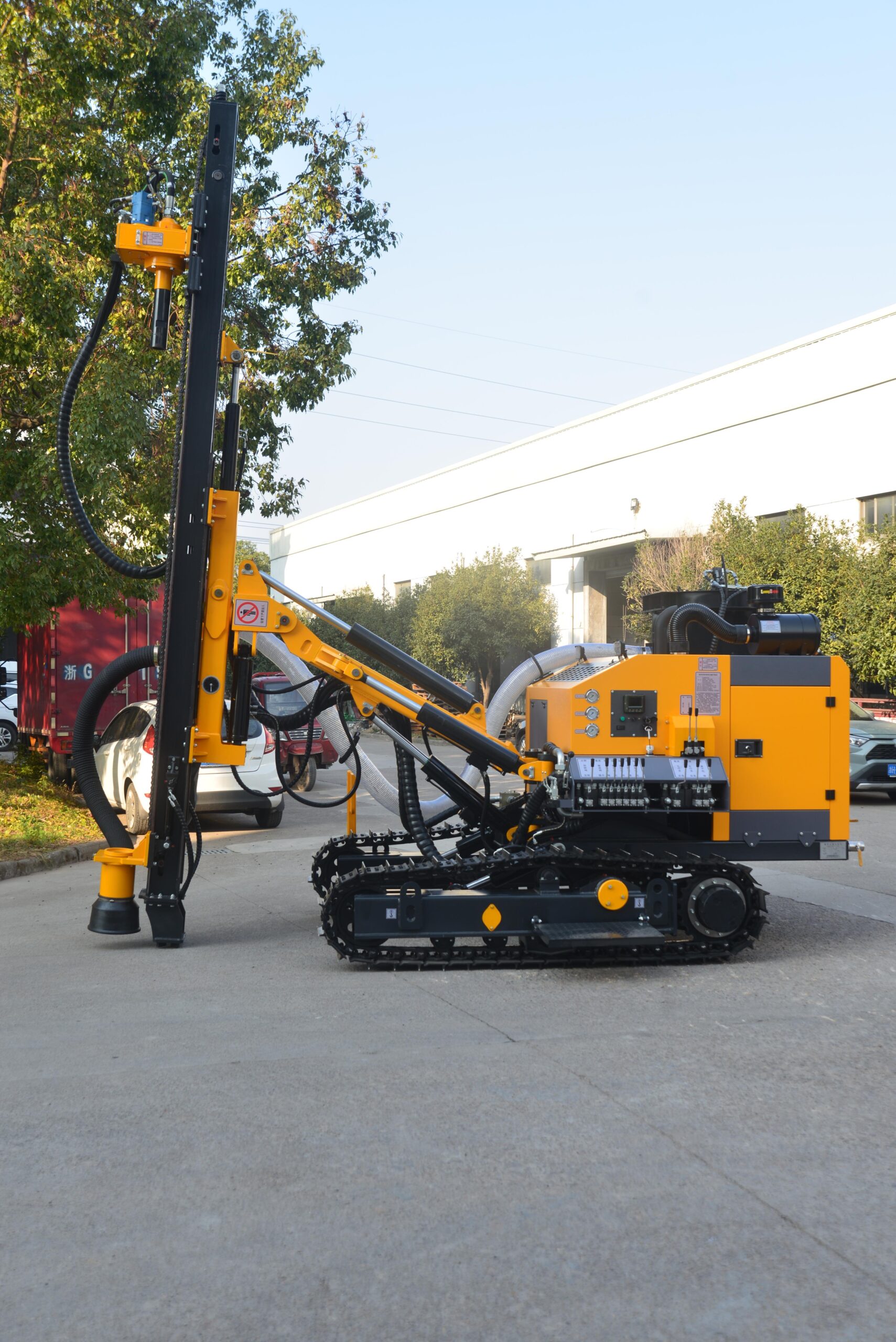
Equipment Guide · Full Hydraulic Drilling Rigs
Full Hydraulic DTH Drilling Rigs: What They Are, When to Use Them, and How to Choose the Right One
By Windrilling Technical Team · July 2026 · 10 min read
A contractor in Tanzania called us in 2024 with a frustrating situation. He’d been running an air-powered top-hammer rig for three years on hard basalt — slow penetration, high bit wear, crew exhausted from constant air pressure problems. When we suggested switching to a full hydraulic DTH rig, his first question was: “What exactly is the difference, and is it worth it for my formation?”
That’s the right question. Full hydraulic DTH rigs are genuinely superior in the right applications — but they’re not the answer to every drilling problem. This guide breaks down the technical differences, the formations they’re built for, and how to evaluate specifications when comparing models.
In This Guide
- What “full hydraulic” means and why it matters
- Full hydraulic DTH vs. air-powered: honest comparison
- Formations where full hydraulic DTH outperforms
- Key specs to evaluate when selecting a rig
- WD-ZJ516: specifications and field performance
- Total cost of ownership: what buyers miss
What “Full Hydraulic” Actually Means
The term gets used loosely — so let’s be precise. A full hydraulic DTH drilling rig uses hydraulic power for all major drive functions: rotation head, feed/pull, mast raising and levelling. The compressor that powers the DTH hammer is a separate unit. Why does that matter? Because hydraulic control over rotation and feed means you can apply independent, continuously variable torque and thrust to the drill string — not fixed mechanical steps.
The three hydraulic circuits at work
- Rotation circuit — drives the top-drive head; torque and RPM adjustable independently while drilling
- Feed circuit — controls downward thrust and pull-back force on the drill string
- Auxiliary circuit — mast raise/lower, levelling jacks, breakout clamps, rod handling
Full Hydraulic DTH vs. Air-Powered DTH: Honest Comparison
Both use a pneumatic DTH hammer at the bit. The difference is everything above the hammer: how the drill string is rotated, how feed pressure is applied, and how the rig responds to changing rock conditions.
| Feature | Full Hydraulic DTH | Air-Powered DTH |
|---|---|---|
| Rotation drive | Hydraulic motor — fully variable | Pneumatic or mechanical — fixed steps |
| Feed control | Hydraulic cylinder — smooth, precise | Chain/mechanical — coarser |
| Max torque | High — suitable for 6″+ diameter | Moderate — better for smaller sizes |
| Hard rock | Excellent — stable thrust at any depth | Good in shallow/medium depth |
| Max practical depth | 200 – 600m+ | 50 – 300m typical |
| Initial cost | Higher | Lower |
Where Full Hydraulic DTH Rigs Excel
Hard and abrasive rock (UCS > 150 MPa)
Granite, basalt, quartzite, diorite. The DTH hammer delivers impact energy directly at the bit face, bypassing the drill string. Combined with hydraulic rotation that maintains optimal bit-face pressure without over-thrusting, penetration rates in hard rock run 3–5× faster than rotary drilling.
Deep water wells (200m – 500m+)
At depths beyond 200m, maintaining consistent hammer energy becomes a real challenge for air-powered rigs. A full hydraulic feed system holds exact downward thrust regardless of string weight — the hammer keeps hitting hard at 400m just as it does at 50m. That’s the difference between reaching the aquifer and not.
Large-diameter holes (>150mm)
Holes above 150mm need substantial rotation torque that most air-driven systems can’t consistently deliver. The WD-ZJ516 provides up to 3,500 N·m at the spindle — enough for 6″ and 8″ DTH hammers without stalling in hard rock.
Key Specifications to Compare
1. Spindle rotation torque (N·m)
This determines the maximum DTH hammer size you can run. A 4″ hammer needs 800–1,200 N·m. A 6″ hammer needs 2,000–3,500 N·m. An 8″ hammer needs 4,000+ N·m. If the rig’s rated torque is too low for your target hammer size, you’ll stall in hard rock.
2. Feed force and pull-back force (kN)
Feed force pushes the bit into formation. Pull-back extracts a stuck string. For deep holes, pull-back matters just as much — you need at least 1.3× the full string weight to safely extract it. Always check both, not just feed.
3. Mast stroke and rod compatibility
Mast stroke determines rod section length per pass. A 6m stroke halves your rod-connection stops vs. a 3m-stroke rig. On a 300m well, that’s 50 fewer rod changes. Over 20 wells, 1,000 fewer stops — which translates directly into shift metres drilled.
WD-ZJ516: Windrilling’s Full Hydraulic DTH Rig
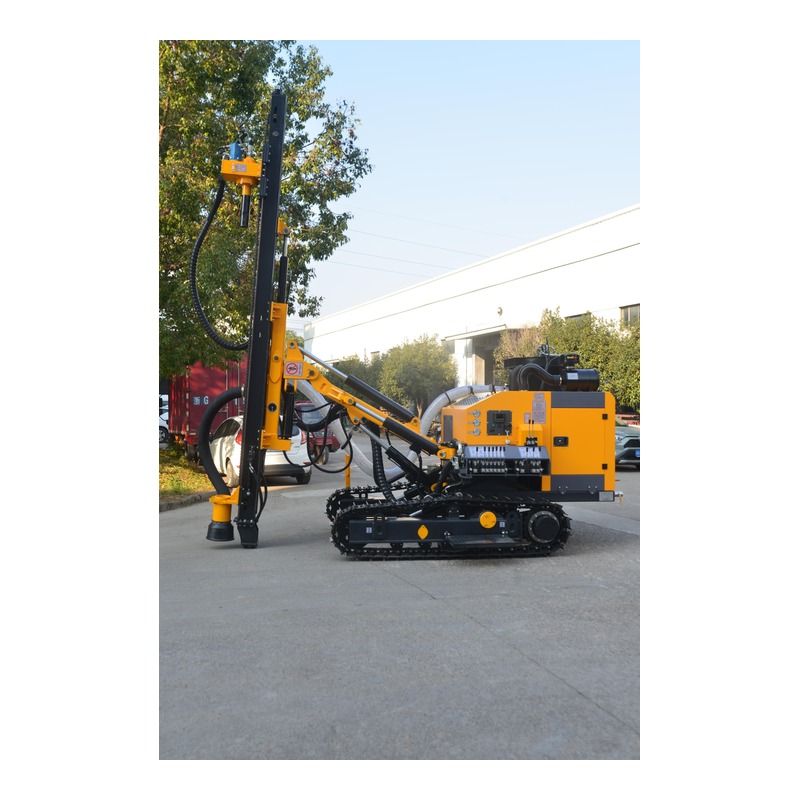
The WD-ZJ516 is a crawler-mounted, full hydraulic DTH rig built for hard rock water well drilling, foundation investigation and blast-hole work. Its compact footprint allows deployment to remote sites without heavy transport equipment.
The 6,000mm mast stroke handles 6m rod sections in a single pass. On a contract of 20 wells at 300m depth, that saves 1,000 rod connections compared to a 3m-stroke rig. Small detail. Large impact on daily production.
Total Cost of Ownership: What Buyers Often Miss
Full hydraulic rigs cost more upfront. That’s real. But the 5-year operating cost often tells a different story once you factor in bit wear, fuel and crew time.
- Bit life: Precise feed control prevents over-thrusting and button crushing — bits last longer in hard rock
- Fuel: Variable-displacement hydraulic pumps draw power only when needed; fixed systems run at full load regardless
- Crew time: Faster penetration rate + fewer rod connections = more metres per shift, directly improving contract revenue
- Downtime: Hydraulic systems generally outperform mechanical gearbox/clutch drives in dirty field conditions
The Tanzania contractor from the opening: after switching to a full hydraulic DTH rig, penetration in basalt went from 4–6 m/hour to 14–18 m/hour. The rig paid for itself within the first major contract.
Is a Full Hydraulic DTH Rig Right for Your Project?
- ✅ Hard rock (granite, basalt, quartzite) — yes, this is the right tool
- ✅ Deep water wells beyond 200m — yes, hydraulic feed control is decisive
- ✅ Large-diameter holes (>150mm) — yes, the torque capacity is necessary
- ✅ High-productivity contract drilling — yes, penetration speed improves economics
- ⚠️ Shallow soft-formation wells (<100m) — an air-powered rig may be sufficient
- ⚠️ Budget-constrained one-off projects — weigh capital cost against contract volume
Discuss Your Drilling Project With Our Team
Tell us your target depth, hole diameter, formation type and country. We’ll recommend the right DTH configuration and provide a complete package quote — rig, air compressor, drill rods, bits and spare parts — within 24 hours.